What becomes scarce is not code. It's knowing what's already been built.
npm has 2.5M+ packages. PyPI has 500K+. Only a fraction are actively maintained and production-suitable. Starlog gives agents structured capability data — not training data.
Every dependency decision is this same fork.
5 matches in the index for “auth for nextjs”
Provides a fully managed authentication and user management platform with pre-built UI components for sign-up, sign-in, and profile management, eliminating the need to build auth infrastructure from scratch.
Implements user authentication in Next.js applications using Auth0 as the identity provider, handling login, logout, session management, token refresh, and middleware-based route protection with encrypted cookie-based sessions.
Provides a declarative JavaScript SDK for integrating Amazon Cognito authentication into frontend and mobile applications, handling sign-up, sign-in, MFA, OAuth/social login, and session management within the AWS ecosystem.
Provides client-side authentication for web and mobile apps using Firebase's managed identity platform, supporting email/password, phone, anonymous sign-in, and federated identity providers (Google, Facebook, Apple, etc.) with no backend auth infrastructure to maintain.
Provides a complete open-source authentication and user management backend with passkey-first support, passwords, MFA, OAuth SSO, SAML Enterprise SSO, and pre-built web components for login/registration UI, serving as a self-hostable alternative to Auth0, Clerk, and Stytch.
Real responses from the Starlog index — captured 2026-06-01.
Pick any capability — it's the same fork. In our benchmark, the agent reached for Starlog on every dependency decision.
Capability Manifests
Not documentation. Not READMEs. Structured, machine-readable descriptions of what each indexed library actually solves — which stacks they fit, when to skip them, and what hosted alternatives cost less than building custom.
- › Each manifest is structured capability data, not prose — stored fields like solves, stack_affinity, integration_effort, best_for, skip_when, and hosted_alternative.
- › integration_effort is a five-level scale (drop-in, easy, moderate, significant, major), so an agent weighs the cost of adopting a library, not just that it exists.
- › Every manifest encodes when NOT to use a library via explicit skip_when anti-patterns — so the agent can rule a library out, not just in.
Capability-Aware Search
Your agent asks ‘I need auth for a Next.js SaaS’ and gets ranked results with integration effort, health signals, and a concrete comparison: ‘Clerk eliminates 2–4 weeks of auth infrastructure work.’
- › Results are ranked by an absolute relevance score (0–100), computed at query time — fit to your task, not download count or stars.
- › Off-corpus queries return ‘no strong match’ instead of a forced answer: because the score is absolute, a query outside the index yields nothing rather than a confident wrong pick.
- › Each result carries best_for, skip_when, a hosted alternative, and — with --context — a ‘vs custom’ build-vs-buy rationale in one line.
One-Command Setup
npx starloghq init. MCP server configured. PostToolUse hook installed. Your agent starts using Starlog for dependency decisions — in our benchmark it called the tool on every one.
- › npx starloghq init wires the MCP server into ~/.claude/settings.json, exposing the starlog_search tool to your agent.
- › A PostToolUse hook fires on npm install / pnpm add / yarn add / pip install and surfaces that package’s skip_when conditions and alternatives as advisory context — it informs, it doesn’t block.
- › Idempotent and previewed: it shows every change and asks before writing; --dry-run previews, --uninstall removes cleanly.
25 libraries, indexed and ranked. Across 7 capability categories — searchable offline, no key.
Not a list of packages — structured capability data for the dependency decisions agents actually face. A broader hosted index is in development; the bundled corpus ships offline.
Authentication
Background Jobs
Caching
Feature Flags
ORM & Database
Realtime
What ships today is the first layer. Here is the shape of the rest.
Everything below is a design direction, not a shipped feature. The capability facts you can install today are layer one of a larger model we are still building — described here so you can see where Starlog is headed, not what it does now.
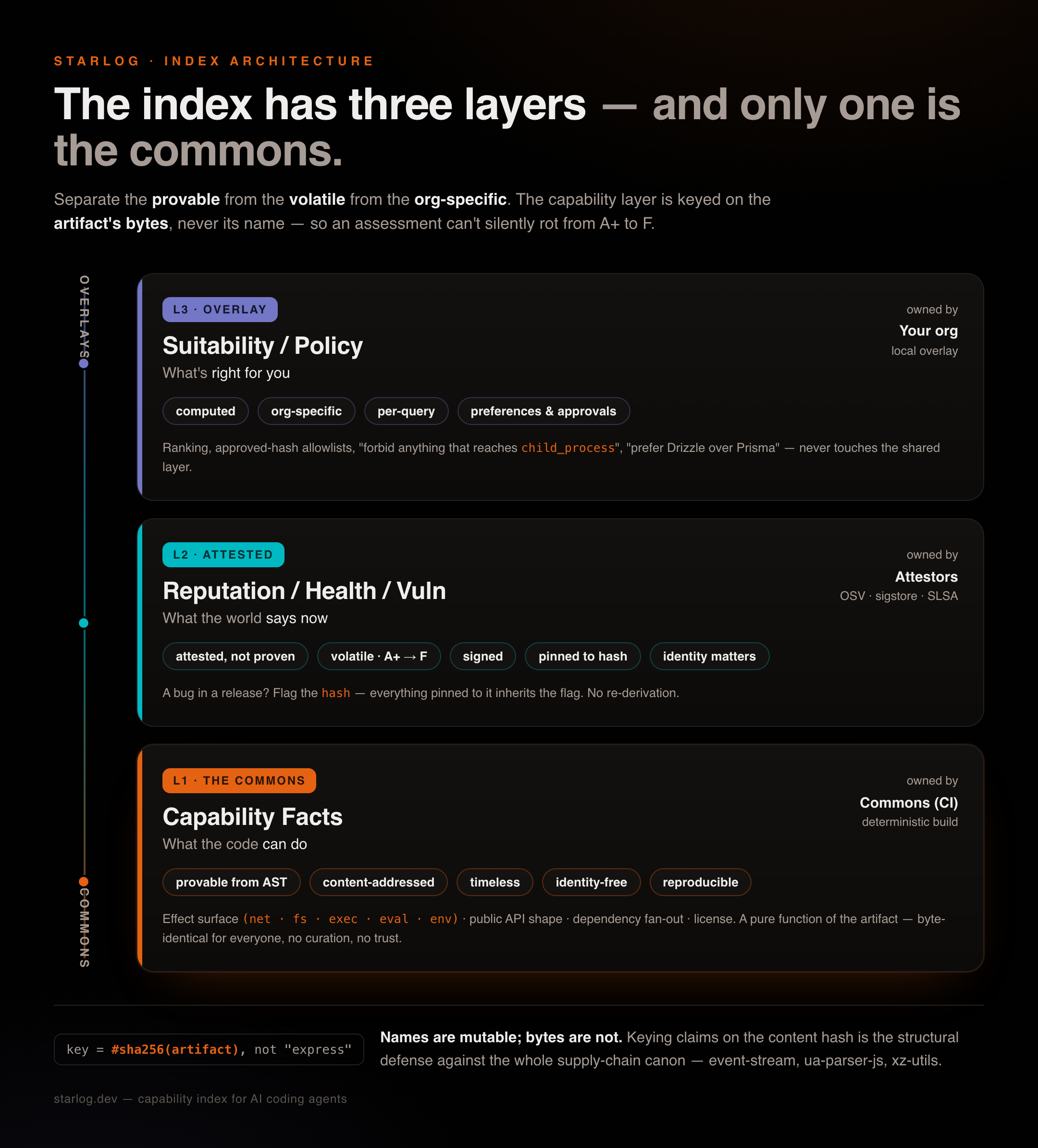
L1 — Capability facts (the commons)
What the code can do— effect surface (net, fs, exec, eval), public API shape, dependency fan-out, license. The plan is a deterministic build artifact, byte-identical for everyone: a capability and effect fingerprint, not a quality score.
L2 — Reputation & vulnerabilities (attested overlay)
What the world says now— CVEs, maintenance, provenance. Never proven, only attested at a point in time, with you choosing whose signatures count. The intent is to consume OSV, OpenSSF Scorecard, and sigstore — not to rebuild a vuln database.
L3 — Suitability & policy (your overlay)
What's right for you — ranking, approved-hash allowlists, rules like "forbid child_processreach" or "prefer Drizzle over Prisma." A thin org-local overlay, computed per query, never a fork of the index.
The idea: capability never changes; suitability does — fit would be computed fresh against your context.
name the bytes, not the name
The plan is to key claims to the content hash of the artifact — #sha256, not "express." A claim keyed on a mutable name silently rots from A+ to F on a force-push, an ownership transfer, or a post-install hijack. Binding facts to the bytes is the structural defense — the same content-addressing that npm integrity, pip hashes, go.sum, and OCI digests already rely on.
In every supply-chain incident worth naming — event-stream, ua-parser-js, xz-utils— the name stayed trustworthy while the bytes changed. Keying on the name is the bug; keying on the bytes is the fix.